
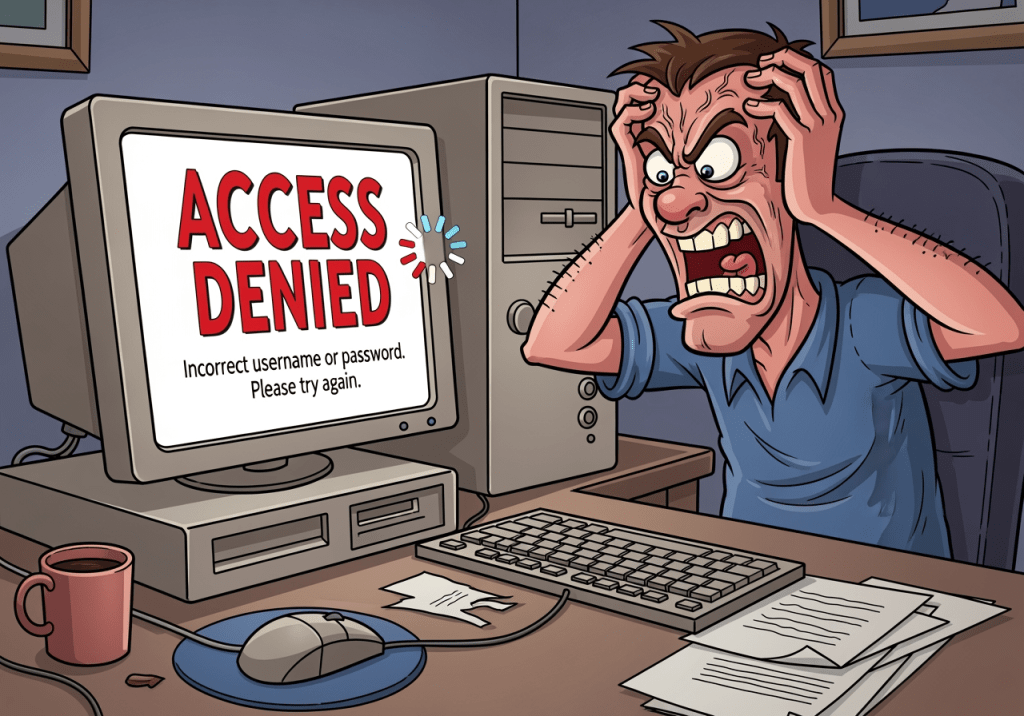
Let’s be honest, passwords are annoying and hard to memorize. On top of that, you’re told they must be long, complex, be memorable but not too memorable at the same time, and definitely not be the same as your other 47 passwords. No wonder so many people use things like “password123” and hope for the best.
But here’s the truth: Your password is the front door to your digital life. And right now, millions of people are leaving that door wide open. Let’s fix that without making your brain hurt.
What is a Password, Really?
Simply put, a password is a secret word or phrase that proves you are you when you log in to something.
When you type your password:
- The website checks it against a stored (scrambled) version
- If it matches, you’re let in
- If it doesn’t, you stay out (hopefully)
Think of it like a key. If anyone else gets a copy of that key… they can walk right in.
How Hackers Break Passwords?
Hackers usually aren’t sitting there guessing your password one try at a time while laughing maniacally. They use automated tools that can try millions or even billions of guesses per second.
These tools use:
- Common passwords lists
- Dictionary words
- Personal info (names, birthdays, pets)
- Previously leaked passwords from data breaches
If your password is simple, it’s not a challenge — it’s a speed bump.
Meet the culprit: Low Password Entropy
Entropy is a fancy word for randomness and unpredictability.
- Low entropy = easy to guess
- High entropy = hard to guess
| Password | Entropy Level | How Long to Crack |
|---|---|---|
| 123456 | Very Low | Instantly |
| password | Very Low | Seconds |
| password123 | Very Low | Seconds |
| CorrectHorseBatteryStaple | High | Centuries |
| g7!Qv#9xP@2L | Very High | Practically impossible |
Hackers love predictable patterns:
- Capital letter at the start
- A number at the end
- A year like 2023 or 2024
- Replacing “a” with “@”
That’s not clever, hackers expect that.
Why Length Beats Complexity Every Time
Here’s a secret most people don’t know:
👉 Long passwords are stronger than complex short ones
P@ssw0rd!(short & fancy) ❌PurpleBananaDancingOnTheMoon(long & silly) ✅
Length increases entropy exponentially.
Each extra character makes a hacker’s job dramatically harder.
Password bad practices continue to be one of the most fruitful vectors for cyber attacks. When creating a password, remember to follow this golden rule:
- Password Length—prioritize long passwords; they have better entropy.
- Password Complexity—mix uppercase/lowercase alphanumeric and non-alphanumeric characters.
- Password Age—Change your password after a set number of days or months
- Password Reuse and History—do not reuse passwords to access different accounts. If one site gets hacked and you reuse passwords, hackers will try that password everywhere else. This is called credential stuffing, and it works shockingly well.
 Mory J. Gbane
Leave a comment